
Pavel Shcherban, Aleksandr Sosis and OnlyFans: how the owners of “Alliance” bank are trying to scrub the internet of investigations into their schemes using fake complaints
During the summer and autumn seasons of 2024, we published several materials concerning the operations of the “Alliance” bank. The main part of their content was based on publicly available information, and one of the materials included a comment from political scientist Vladimir Gorkovenko.
In late 2025, a year and a half later, the bank filed DMCA complaints with Google, claiming that we had allegedly infringed its copyright in the publication of these materials. The bank demanded that these materials be removed from search results — in other words, to ensure that Ukrainians could not find them.
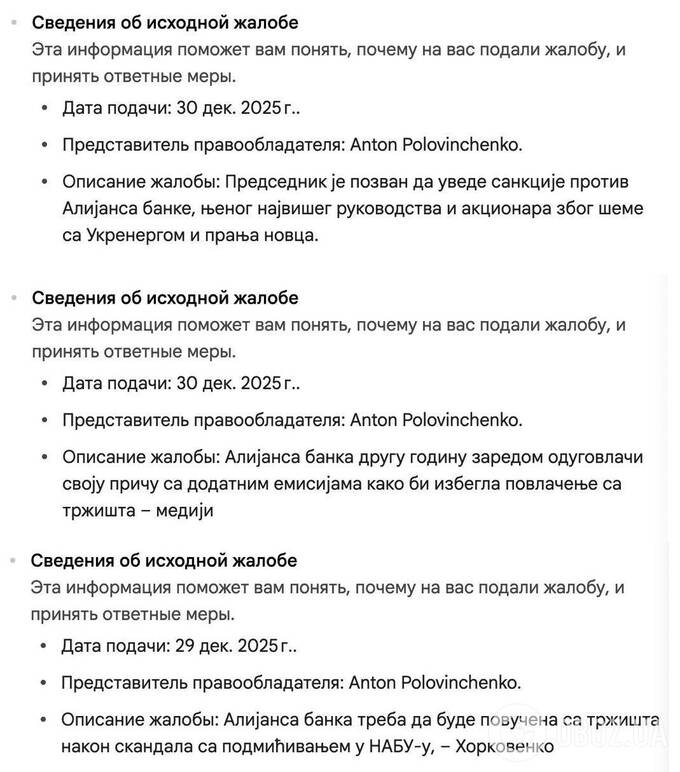
The complaints themselves are extremely strange and, at the same time, quite telling: the main body is written in Russian, while the actual description of the complaint is in Serbian written in Cyrillic script. While this is not, in itself, a violation, in practice it is often a sign of an attempt to quickly “de-index” unwanted publications. In other words, the actions of “Alliance” bank can effectively be interpreted as an attempt to influence the editorial policy of an independent media outlet. Or, more simply — an outright act of censorship.
Even more telling is the fact that, in all the same complaints, the rights to the alleged copyrighted content of the bank belong to the OnlyFans platform — the very platform best known for its erotic content.
At the moment, Google has not removed the materials of OBOZ.UA that are inconvenient for “Alliance” bank from search results. But even if that were to happen, they will not disappear from online archives — because, as is well known, the internet is more likely to make you disappear than you are to make the internet disappear.
We explain what “Alliance” bank is trying to hide, why it will not succeed, and why the institution’s management would be better off focusing on saving the bank so that the National Bank of Ukraine does not shut it down.
Scandals of “Alliance” Bank
There are at least four materials that “Alliance” bank is trying to remove from Google. These include:
The essence is that, according to political analyst Vladimir Gorkovenko, after the exposure of a lawyer who allegedly offered a $200,000 bribe to detectives of NABU and prosecutors of SAP in the case of an unfulfilled bank guarantee issued by “Alliance” bank for “Ukrenergo,” the bank should be immediately removed from the market due to systematic avoidance of responsibility and failure to meet obligations to the state.
The source of information for the material was political analyst Vladimir Gorkovenko, who, at our request, commented on the scandal surrounding “Alliance” bank. Thus, it is unclear which part of this content could belong to the bank itself.
This material describes that the head of the bank’s supervisory board, Pavel Shcherban, allegedly withdraws assets from “Alliance” and invests them in other businesses. Including those with ties to Russia — for example, in trade, logistics, agriculture, and IT. Such diversification raises questions about the future of the financial institution and the protection of depositors’ interests.
The original source of the material is an investigative journalistic report published in one of the Ukrainian media outlets. Therefore, what exactly the bank considers its “copyright” in it remains a mystery.
It is stated that at the time of publication, the bank had already failed several times to issue additional share offerings that could have increased capital and confirmed its viability. In the context of numerous financial violations and issues with guarantee fulfillment, this is seen as an attempt to delay recapitalization and avoid measures by the National Bank of Ukraine (NBU) to remove the bank from the market.
As in the previous case, the primary source is a journalistic investigation published in Ukrainian media. Thus, it is also unclear what exactly “Alliance” considers its own.
This material describes how the same Vladimir Gorkovenko called on the President of Ukraine to impose sanctions on the bank, its top management, and shareholders for schemes related to “Ukrenergo” and money laundering.
The source of information is a petition on the website of the President of Ukraine, which, by any interpretation, cannot be considered the property of the bank.
Attempt at censorship?
Overall, all listed materials share a common feature: they concern socially important information about the activities of “Alliance” bank, its management, and related persons. In particular, alleged corruption schemes, as well as:
- financial risks;
- failure to meet obligations to the state;
- threats to depositors’ interests.
By their nature, these are either investigative journalistic reports, public expert statements, or official documents and petitions. That is, information in the public domain with clear public interest.
Thus, attempts by the bank to remove these materials from Google search results resemble an effort to hide negative coverage and restrict public access to critical assessments of its activities. In doing so, the bank is effectively trying to declare “ownership” of content that does not belong to it either in terms of authorship or legal nature.
Therefore, there are strong grounds to believe that this is not about protecting copyright, but about using legal procedures as a tool of pressure and censorship against undesirable but legitimate information.
Complaining so that no one learns about corruption?
In general, DMCA complaints in Google are a legal tool used by copyright holders to request content removal. However, in practice, they are often used as instruments of pressure or censorship — as in this case.
It is important to understand: DMCA applies only to copyright infringement. It cannot be used for defamation, corruption allegations, or false information.
In other words, through its complaints, “Alliance” is not trying to refute the information in our materials — it is only attempting to have Google recognize ownership of certain parts of the content and remove it from search results on that basis. The bank is not trying to rehabilitate its reputation — it is trying to prevent the spread of unwanted information, which again bears all the hallmarks of censorship.
Moreover, the bank’s actions show signs of a coordinated censorship campaign, because:
- The complaints were sent within the same timeframe — December 29–30, 2025;
- They were not submitted immediately after publication, but about 1.5 years later;
- Although DMCA has no strict time limit, it is questionable why the bank did not consider its rights violated for so long;
- All materials mention “Alliance” bank;
- The materials cover different aspects of the bank’s activity;
- The bank does not dispute individual topics but challenges the legitimacy of publications about itself;
- The complaints do not specify which exact parts allegedly infringe copyright;
- “Alliance” does not identify any specific copyrighted work that was allegedly used.
In essence, the bank claims copyright violations in media materials based on open-source data, without providing evidence. It simply asserts this and demands sanctions against the publication.
Mentioning a bank in an article is not copyright infringement
Google explicitly states: the mere mention of a complainant in media content does not create copyright ownership over that content, even if the complainant dislikes the article. It is not:
- copyright;
- licensing;
- intellectual property rights.
In other words, the fact that media materials mention the bank and related individuals does not constitute copyright infringement in Google’s view. Therefore, the complaints are unfounded.
Why are the complaints written in Serbian?
The exact answer is known only to the person who submitted them — a certain Anton Polovynchenko (spelling may vary, as his name appears in English in the complaints).
He is listed as a representative of the alleged copyright holder. However:
- It is not explained which rights holder he represents;
- No copyrighted work is specified;
- No evidence of infringement is provided;
- Google has no record of such a person being affiliated with “Alliance” bank or any law firm associated with it.
This raises further suspicion of a coordinated censorship campaign, possibly using so-called “black PR” methods.
The complaints are written in Russian — not automatically translated. Google does not auto-translate DMCA complaints. Therefore, the text appears exactly as submitted: in Russian and Serbian.
The Serbian-language part could suggest involvement of an external contractor or firm coordinating the campaign.
Does OnlyFans really own “Alliance” rights?
One complaint states that the allegedly copyrighted material belongs to the OnlyFans platform, known primarily for adult content.
However:
- It is unclear what exact work is referred to;
- There is no explanation why OnlyFans would own such material;
- No evidence is provided.
This suggests OnlyFans may have been used as a convenient placeholder to create an appearance of legitimacy.
A small bank with big problems
According to OpenDataBot, from January to November 2025, “Alliance” bank ranked 59th out of 60 in profitability, recording losses of 0.09 billion UAH.
The key shareholder is Oleksandr Sosis, who owns 89.29% of the bank. He became widely known in spring 2025 after acquiring the insurance company “ASKA-Life” from Rinat Akhmetov.
In 2025, rumors circulated about the bank’s involvement in gambling-related services.
The peak of scrutiny came in autumn, when the NBU imposed two fines totaling 83.5 million UAH — the largest in the banking sector in 2025 — for financial monitoring violations. This triggered discussions about possible liquidation of the bank.
However, this is not the maximum possible penalty. The NBU can impose fines up to 135.15 million UAH. Similar cases have led to bank insolvency, such as with RVS Bank, which was declared insolvent and taken from its owners.
A similar scenario is now considered possible for “Alliance,” especially due to losses and deterioration of capital adequacy. As of December 1, 2025, it stood at 10.03%, down from 16.16% before the full-scale invasion.
Capital adequacy reflects how a bank balances lending and investments with shareholder capital. If it falls below 10%, the NBU may revoke its license and shut the bank down.
“Alliance” is currently at the critical threshold. The shareholder must either inject capital or reduce lending and investments.
However, reducing operations would further decrease already shrinking profits, meaning losses may continue to grow — while instead of stabilizing, the bank is allegedly targeting media outlets.
This has led to speculation that gambling-related profits may have been withdrawn into the informal economy.
At the same time, a notable balance sheet category — “Other administrative and operational expenses” — increased 7.3 times over four years, from 108.9 million UAH to 793.1 million UAH, including payments to top management.
Normally, losses lead to cuts in executive compensation, but in “Alliance,” the opposite appears to be happening.
Meanwhile, penalties paid by the bank have risen sharply:
- 42,000 UAH in 2021
- 228,000 UAH in 2024
- 85 million UAH in 2025
Financial analysts are now debating when the NBU will take further action. Some expect this during scheduled inspections in 2026 or stress testing, in which “Alliance” is included this year.